State Implementation
You already have a starting position. Federal work is done once and shared. Your effort goes where only your law can take it — and your policy authority signs off before anything reaches production.
You are not starting from zero
Your state's published federal-source values are already in the model.
The 51-jurisdiction table already carries your state's published federal-source standards and elections — cached and encoded, with per-cell provenance recording whether each value was verified against statute, derived by published arithmetic, or reported as a state election. No unclassified cells.
The adoption process
What a first engagement realistically involves.
Your sources into the corpus
Statutes, regulations, your State Plan and its amendments. Each one cached, hashed, self-proved and versioned, so that months later anyone can show which exact text a rule was built from — and prove it has not moved underneath them.
Your elections inventoried
For each federal option, one of three answers: elected, not elected, or gap named. In New York this produced elections concluded with a citation, elections proved absent with evidence, and gaps explicitly named rather than quietly assumed away. A named gap is a deliverable, not a failure.
Your state layer authored on the proven pattern
Thresholds, overlay and state-specific programs — built the same way the federal layer was built, and closing on the same machine gate. Depth grows state by state, and it is your law that makes it deep.
Your policy authority signs off before production
Two things, and neither of them is ours to decide. See below.
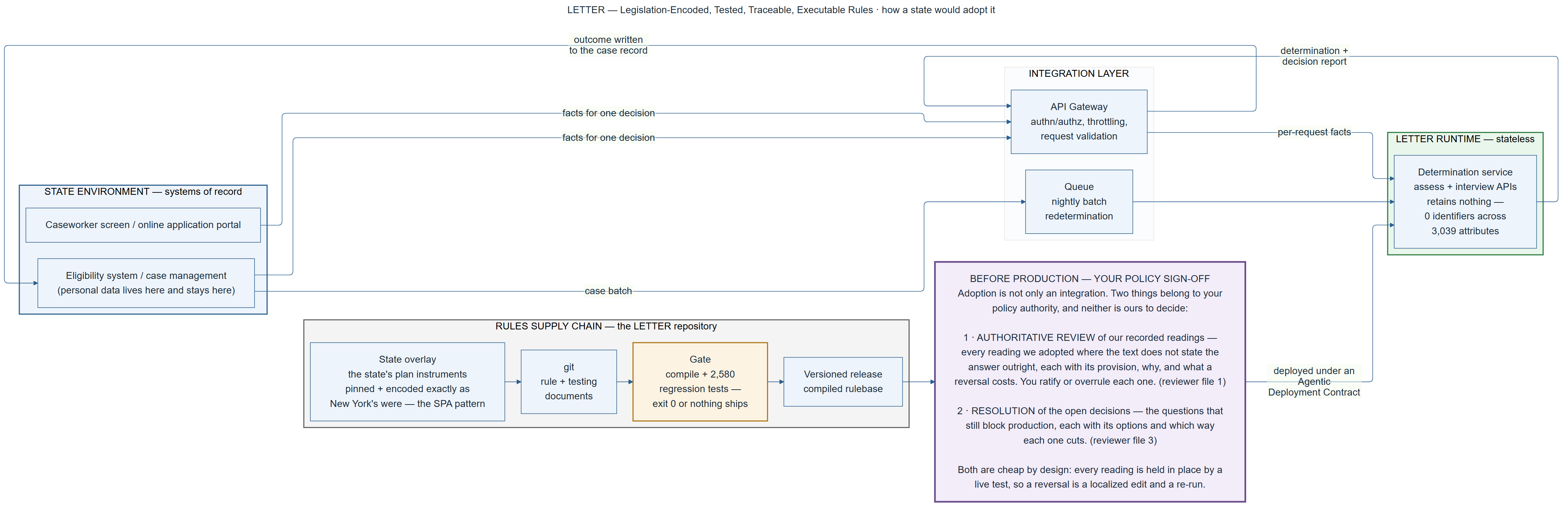
Before production — your policy sign-off
This is a gate on the deployment path, and it is deliberately not ours to pass. Two things arrive at your policy team, in plain English, with no code and no internal shorthand:
- An authoritative review of the readings we recorded. Every place the text does not state the answer outright, handed to you with the provision, our reading, why we adopted it, where it is encoded, and what a reversal would cost.
- Resolution of the open decisions that still block production, each with its options and which way each one cuts.
Overruling one of our readings is cheap and safe by design. Because the tests make every reading live, a reversal is a localized change rather than a rebuild — and the test that defended the old reading goes red the moment it is reversed, so nothing slips through silently.
The honest limits
What only you can fix — said up front rather than discovered later.
History we will not invent
Some inputs need historical facts — a state election as of a date in 2010, for example. Web archives of old federal pages were declined as a source: not good enough to base a determination on. So the model answers unknown before its cached horizon, and says so.
If you want depth there, you provide the authoritative history: your own registers, publications, State Plan and amendment record — generally better than any archive.
Your own instruments disagreeing with each other
It happens. In one live case a state's approved instruments state two different income levels, and the arithmetic behind each is exact to its own published figures. The model declares both and prefers neither — so the standard, the excess, the spend-down and the eligibility date all remain honestly unanswerable until the state says which instrument governs.
Only your policy team can make that call. We will not make it quietly on your behalf.
Meanwhile the federal layer's history already reaches back: poverty guidelines across 44 years, each cited to the register notice for that year.
What you keep
Portable regardless of platform.
The contracts, the gate, the recorded readings, the reviewer layer, the findings ledger, the generated dictionary and the evidence trail. LETTER is a method and an artifact, not a lock-in: nothing described on this site depends on which runtime the rules are compiled onto.
The corpus
Your law, cached and hashed, with the provenance of every value you rely on.
The record of readings
Every interpretation we made, in plain English, with what changes if you disagree.
The gate and the evidence
One command that says yes or no, and a folder per change that an auditor can open.